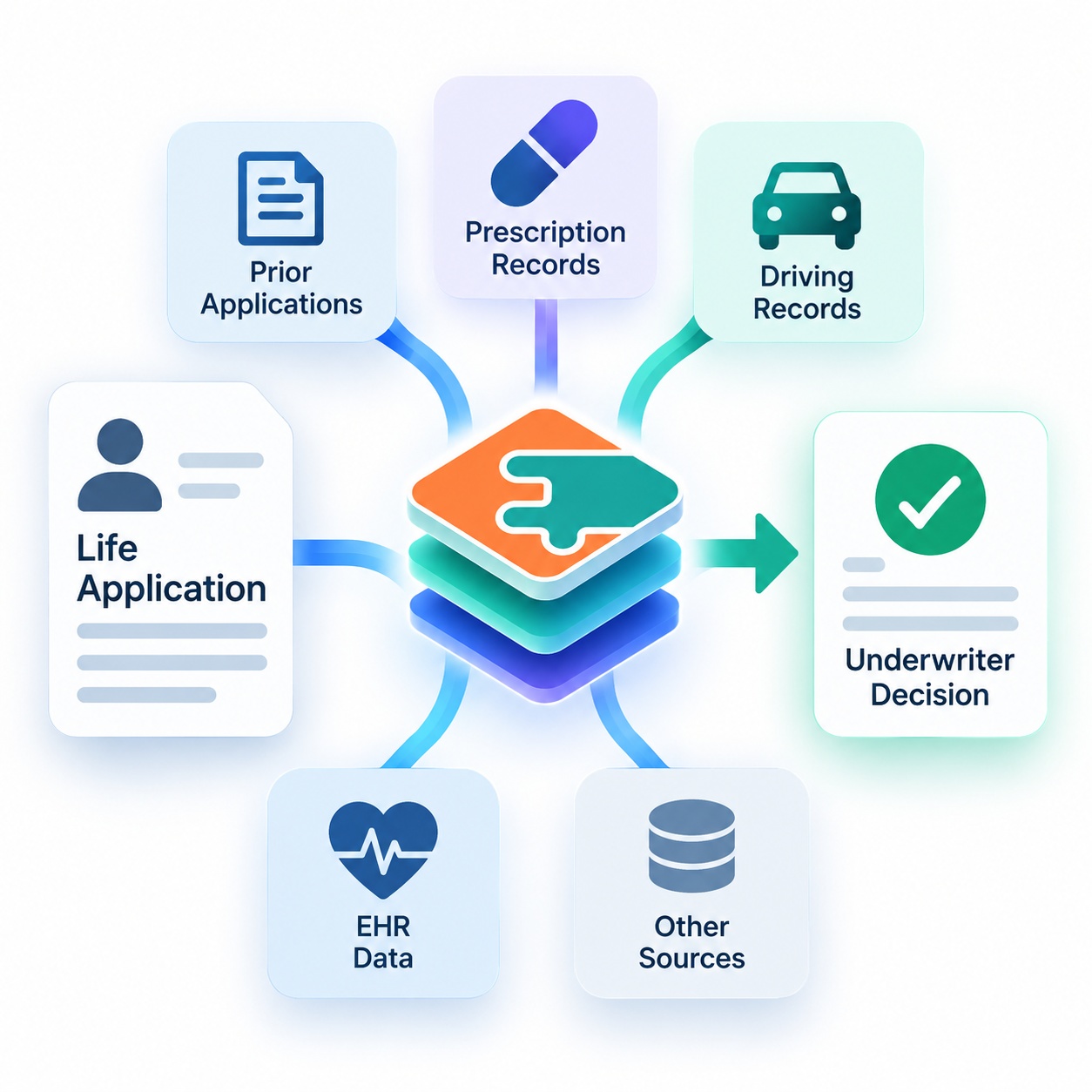
Every life application triggers the same scramble: order prior-application history, prescription and driving records, and increasingly EHR data; wait for vendors to reply; then piece the answers together before deciding. Embedify turns that scramble into one configured flow. The application arrives, the carrier's rules decide which evidence to order, every source is called at once, the answers are merged into one timeline, and the result lands inside the underwriter's own workbench — with every fact traced to its source. The underwriter keeps the decision. Embedify keeps the plumbing.
Life underwriting is not short on data. It is short on a fast, trustworthy way to bring the data together.
Meet Dana. She is 41, healthy, and applies for $750,000 of term life through her advisor on a Tuesday. Her application is complete in twenty minutes. What happens next is the story every carrier knows. The new-business system asks MIB whether she has applied elsewhere. A second request goes to a prescription-history vendor. A third to the DMV for her driving record. A fourth, if the carrier has the connection, to her electronic health record. Each vendor answers in its own format, on its own schedule — some in seconds, some in days. When the answers arrive, an underwriter opens four windows, lines the facts up by hand, and only then decides whether Dana can be approved today or needs a doctor's review. Dana, meanwhile, is waiting. Her advisor is waiting. And every day of waiting is a day she may buy elsewhere or give up entirely.
None of this is caused by bad people or bad systems. It is caused by the connections between the systems being built one at a time, by IT, as separate projects — and then never quite finished. (Dana is an illustrative applicant, not a customer.)
MIB, prescription history, motor-vehicle records, EHR, labs and physician statements each come with their own login, format, error codes and callback behavior. A carrier that wants to add one new source scopes a fresh integration project — and, in Embedify's experience building these connections, most of that work repeats what was built for the last one.
Vendors answer on their own clocks, and at many carriers requests still go out one after another rather than all at once, so a slow source holds up the whole case. LIMRA's 2019 survey found traditional underwriting averaged 27 days to a final decision versus 9 on automated and accelerated paths — and every extra day is a chance for the applicant to walk away.
The data arrives, but not as one picture. Underwriters reconcile a prescription list against a medical record against an application answer, in different screens, to work out what is really going on. The Society of Actuaries' 2026 expert panel on AI in life underwriting lists fragmented evidence and getting integrations into production among the constraints on faster, more consistent decisions.
When rules are broad or dated, cases that could have been decided automatically get referred to a medical director. RGA's 2026 research estimates 15–40% of those referrals can be safely avoided with sharper rules and better evidence integration. Regulators in more than half of U.S. states now expect carriers to explain how outside data and models shaped each decision; a chain of hand-offs makes that hard to prove.
The problem is not the evidence. It is the months of integration work standing between the evidence and the underwriter. Embedify sits between the systems a carrier already owns. It does not replace the e-application, the underwriting engine, the workbench or policy administration — it connects them.
Here is Dana's application again, this time at a carrier running Embedify. Her advisor submits the same form. The new-business system sends one event to Embedify. The carrier's own rules — configured by the new-business team in Embedify's visual Portal, not coded by IT — look at her age, the face amount, the product and her consent, and decide she needs MIB and prescription history but not a driving record. Both requests go out at the same moment. Embedify waits, retries a timed-out call, and merges the two replies into one timeline of Dana's history. The carrier's approved rules run against that timeline and find nothing that needs a human. Within the hour Dana's case is marked eligible for straight-through issue, written back to policy administration, and the full trace of what happened is one click away in Portal. If something had needed a second look, the same timeline — with each finding, its source and the reason it was flagged — would have appeared inside the underwriter's workbench, where they already work.
Configuring that flow is business-user work measured in hours. Adding a fifth evidence source later is a change to the flow, not a new project.
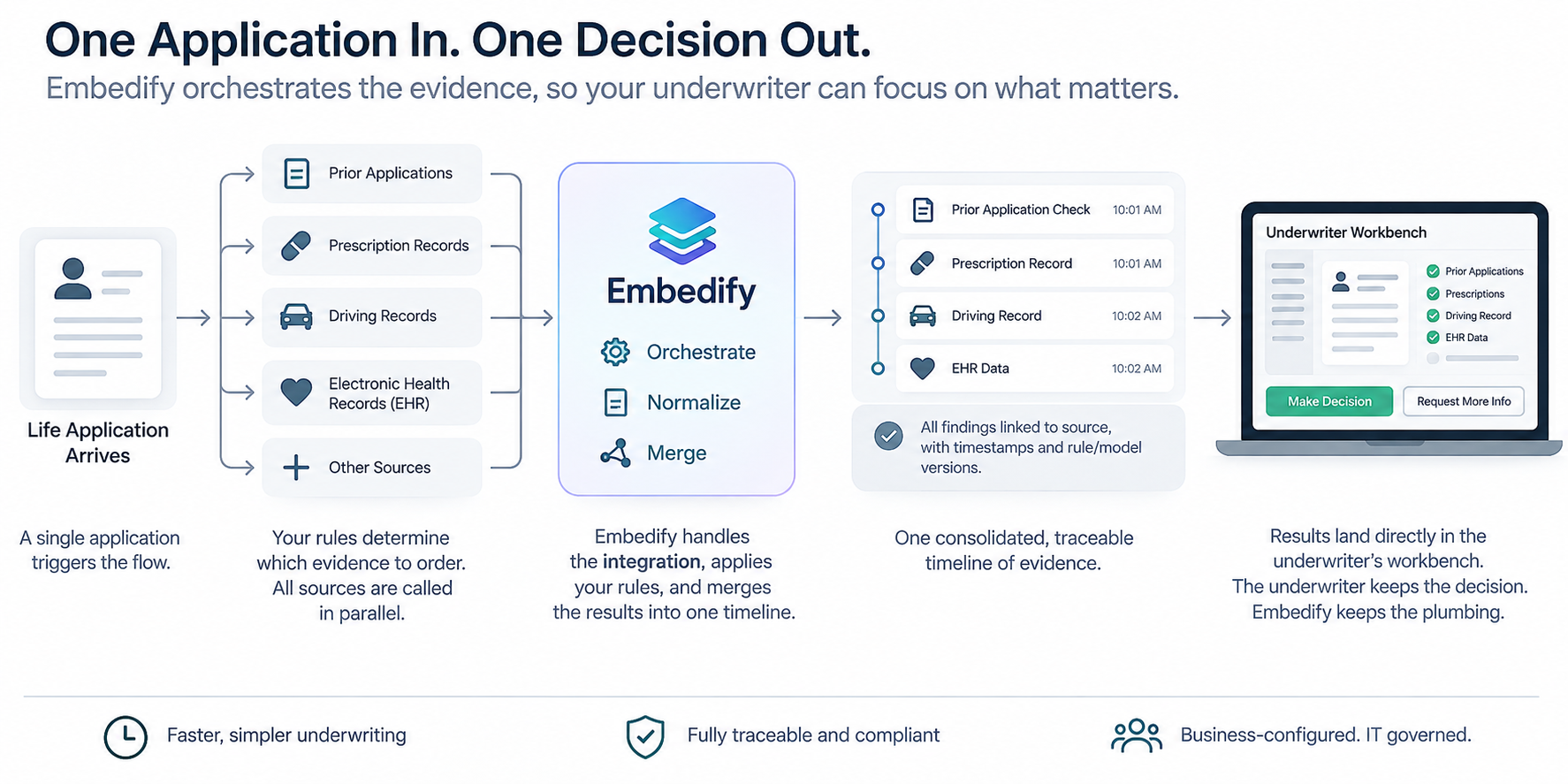
Who does what. The new-business team owns the outcome and configures the flow. IT governs the rails — credentials, environments, approvals. Embedify runs the platform. Nobody writes glue code.
Evidence aggregators, reinsurer engines and workbench products each solve their own slice and want to be the center. Embedify sits between the systems you already own, connects all of them, and stays neutral about which ones you use.
$0.005 per application, no platform fee, no seat licenses, no professional-services engagement. Adding a source is an edit to a flow, not a new project or a change order.
The same flow pattern runs Embedify's P&C and non-insurance use cases, promotes across dev, UAT and production, and traces every event by correlation ID from Portal.
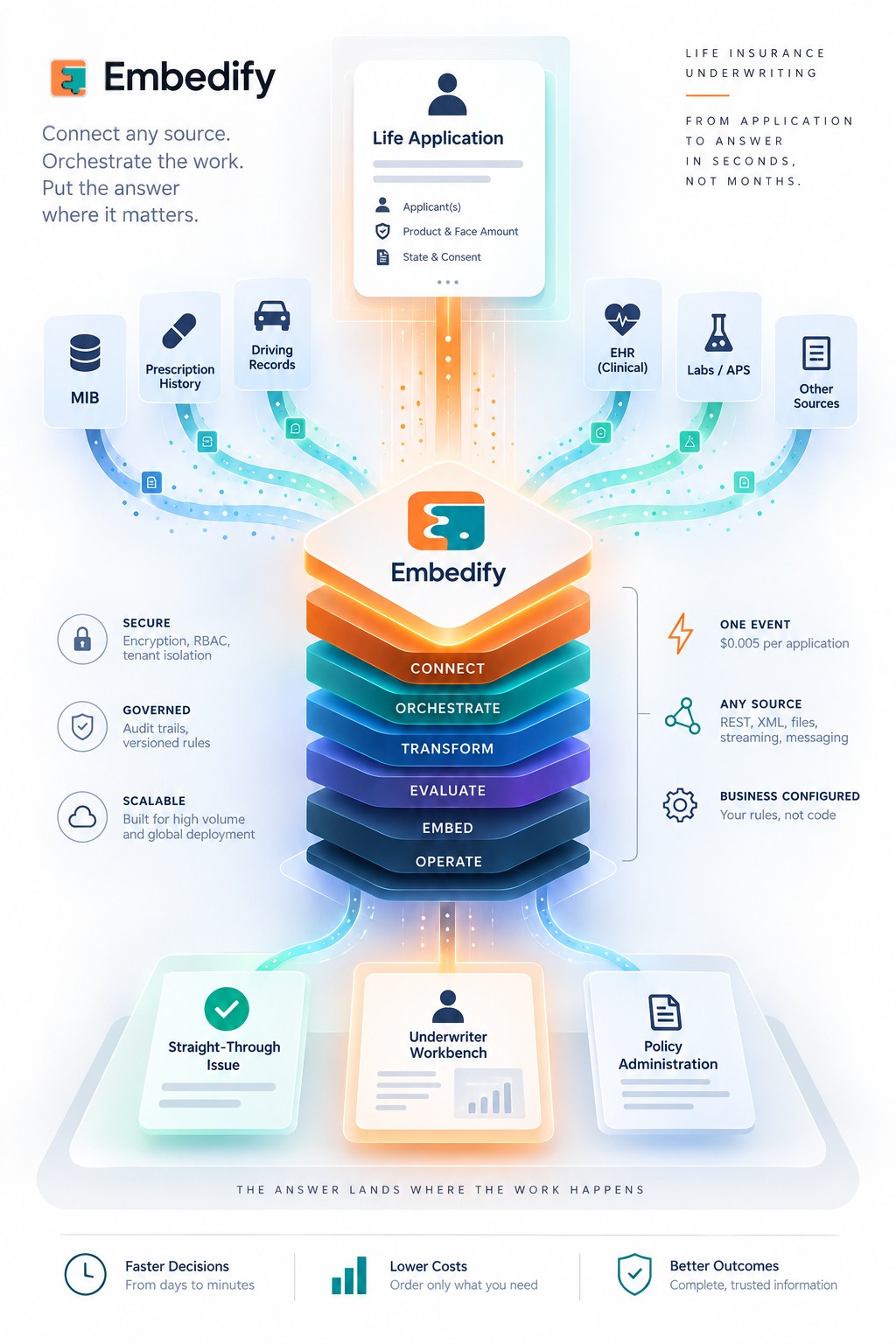
The e-application or new-business platform sends one event — REST, ACORD TXLife/XML, file or stream. Embedify reads the applicant, product, face amount, state and consent, and opens an isolated context for each proposed insured (one for a single life, two for a survivorship case).
The carrier's rules pick the sources: for example, inside the accelerated program with valid consent, order MIB and prescription history; add a driving record only if the product requires it; add EHR above a face-amount threshold. Nothing unnecessary is ordered, which keeps vendor fees down.
Embedify spreads out to every selected source in parallel, handles the ones that answer later by callback or polling, retries failures, and collects the replies. To the carrier this is still one event and one $0.005 charge; vendor fees are unchanged and separate.
Each source is mapped into one canonical timeline for the insured: prescriptions, encounters, diagnoses, labs and driving events in date order. Every fact keeps its source, timestamp and confidence. Conflicts are preserved and flagged, never silently overwritten.
The carrier's approved rules or its underwriting engine — in-house, or a reinsurer's such as Swiss Re Magnum or RGA AURA NEXT — run on the timeline. Clean cases go straight through. Cases that need one more answer get a reflexive question. Nuanced cases go to an underwriter or medical director with the reason attached.
Lens embeds the case inside the underwriter's existing workbench: case status, evidence timeline, findings grouped by condition, and the exact reason for routing. Approved cases are written back to policy administration. Every step is monitored, versioned and traceable from Portal.
Traditional underwriting vs. automated and accelerated paths — the most recent published LIMRA benchmark. Parallel evidence ordering and straight-through routing are how the gap closes.
RGA (May 2026): share of medical-director referrals that sharper rules, reflexive questions and integrated evidence can safely remove.
Pacific Life 2026 survey of 103 underwriting executives — every new source is a new integration unless the connection layer is already in place.
However many sources it fans out to. Cost is predictable per case and cannot spike when a new source is added.
One inbound request drives the whole chain. Each step is a visual block in the Embedify Portal; the carrier configures the rules, Embedify runs them.
See how Embedify transforms integrations in your industry.
Schedule a demo or start a self-service configuration. No consulting. No change orders. No surprises.