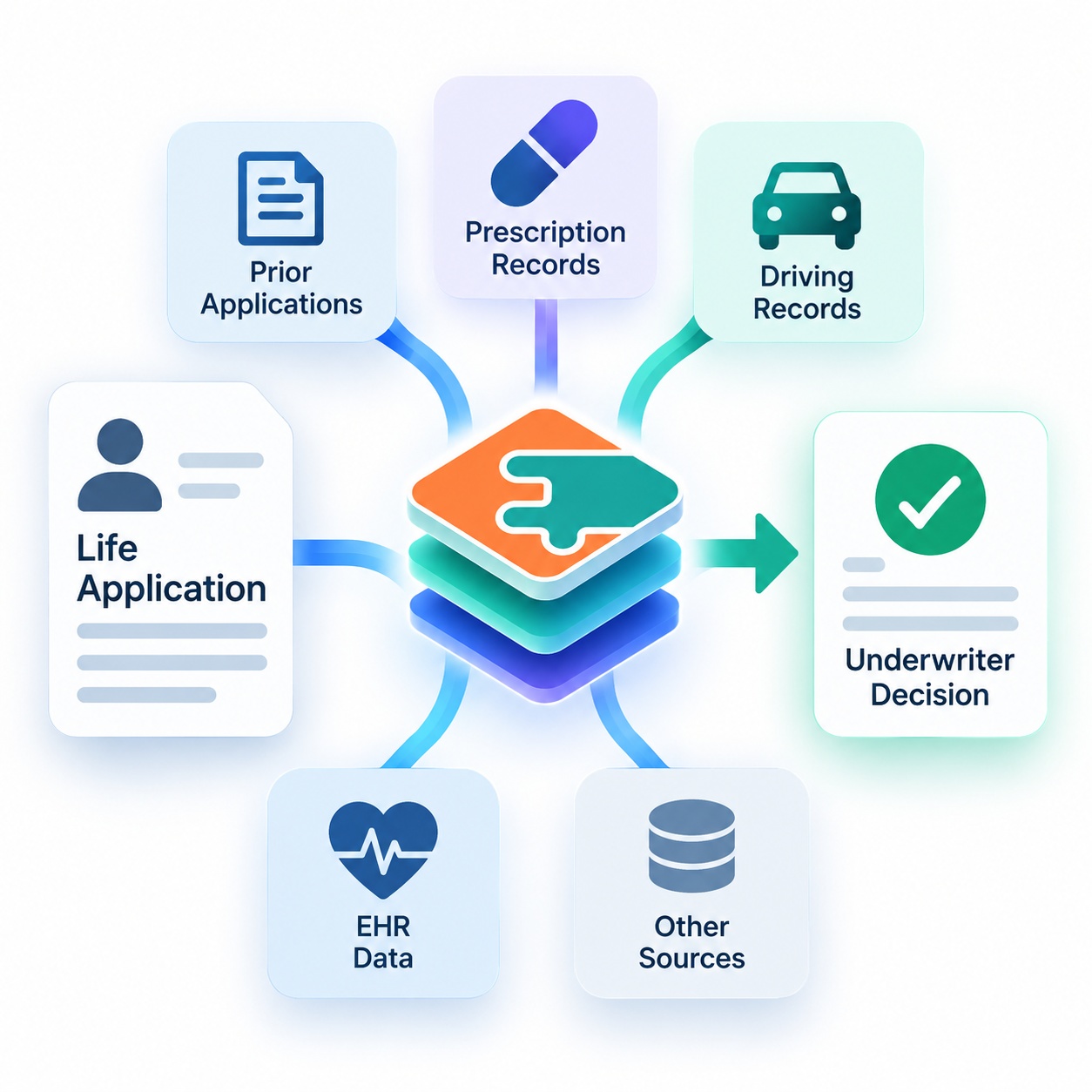
P&C carriers have invested millions building and buying predictive models; fraud scores, risk grades, severity estimates, renewal predictors. Yet industry research consistently finds that the majority of machine-learning models never reach production, leaving carriers with backlogs of completed analytical work that has never influenced a live decision. Embedify clears that backlog. Business teams configure model integrations in days, surface outputs directly inside their core P&C systems, and pay zero consulting fees.
Independent industry research consistently finds that 53–87% of machine-learning models never reach production. For a typical P&C carrier with a 30–50 person data-science function, that translates to dozens, and at larger carriers, well over a hundred completed predictive models sitting in registries, data-science platforms, and vendor portals: fraud scores, risk grades, severity estimates, renewal predictors. They work. They've been validated. They've never influenced a single live decision.
Getting a model output into any core system requires a formal integration project: scoping, vendor engagement, custom development, testing, and deployment. Each project routinely runs 300-400+ hours and costs $150K–$500K in professional-services fees, with IT and integration backlogs stretching 18–24 months. Business teams have quietly accepted a painful reality: the models they built to sharpen decisions are sitting idle while those decisions keep getting made without them.
Every new model adds to a queue that IT and system integrators cannot keep pace with. Requests age out. Priorities shift. The fraud model scoped in January ships in October, if it ships at all. For carriers with active data-science programs, the backlog grows faster than it's cleared. The bottleneck isn't the models. It's getting them connected.
A single integration engagement routinely costs $150K–$500K before a model output ever reaches a user, which is consistent with industry analytics-consulting benchmarks. When integration costs approach or exceed the projected value of the model, finance teams kill the project. The result: expensive analytics investments that never generate ROI, and not because the models don't work, but because deploying them isn't economically justified under the current cost structure.
Model outputs end up in dashboards, weekly reports, and exported spreadsheets, and not inside the core system at the moment of decision. An underwriter under time pressure won't open a separate tab to check a risk score. A claims adjuster triaging 40 open cases won't cross-reference a severity report. If the insight isn't surfaced in the workflow, at the moment it's needed, it doesn't change the decision. It just generates a prettier report that nobody reads.
Models get updated. Thresholds shift. Data sources change. Every update to a model that has a custom integration behind it means a new scoping call, a new statement of work, and another 6–12 weeks of waiting. Business teams stop asking for updates because the process is too painful and models silently degrade while still influencing decisions downstream.
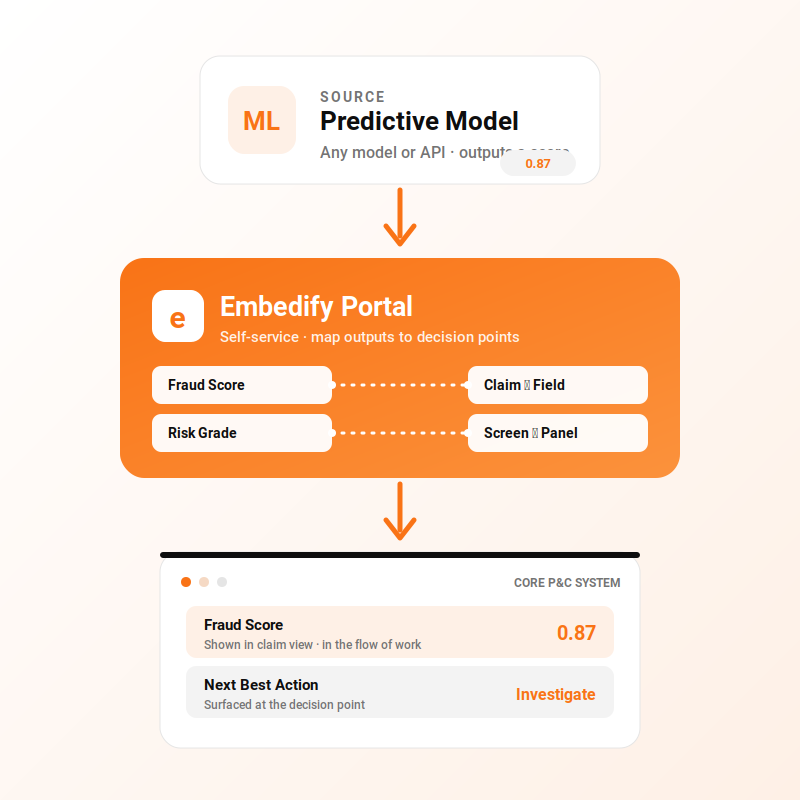
Embedify connects predictive model outputs to the workflows where decisions are actually made without consulting engagements, custom development, or change orders. Business teams configure integrations themselves through a self-service portal, mapping model outputs directly to fields, screens, and decision points inside their core P&C systems. When a model is updated, the integration is updated in minutes. No new engagement. No new fee. Business teams configure. IT governs. Embedify operates.
But moving data is only the beginning. Embedify transforms predictive outputs into operational intelligence by applying business rules, orchestrating downstream workflows, triggering automated actions, and embedding recommendations directly inside the applications where employees work every day. Instead of sending users to another dashboard or report, Embedify delivers the right prediction, in the right business context, at the exact moment a decision needs to be made.
Several core-system vendors now offer in-product analytics tooling. Embedify is built on three principles those tools cannot match.
Connect your existing AWS SageMaker, Databricks, Azure ML, Google Vertex AI, or custom in-house endpoint without migration. No proprietary modeling stack required, no vendor lock-in for your data-science team's existing investments.
Surface insights into PolicyCenter, ClaimCenter, BillingCenter, and adjacent systems including downstream tools like CRM, BI dashboards, and operations platforms. One integration, multiple destinations, instead of one vendor's product family.
Simple per-request pricing with no platform fee, independent of your core-system contract. Your teams can configure and manage solutions directly, while IT retains governance and visibility. No system-integrator dependency, no professional-services engagement, and no consulting markup.
Point Embedify to where your model lives: your scoring API, your cloud ML platform (AWS SageMaker, Databricks, Azure ML, Google Vertex AI, or any custom endpoint), or your vendor's hosted service. Enter the URL and credentials in the Embedify Portal. No custom integration development and no migration of your model required.
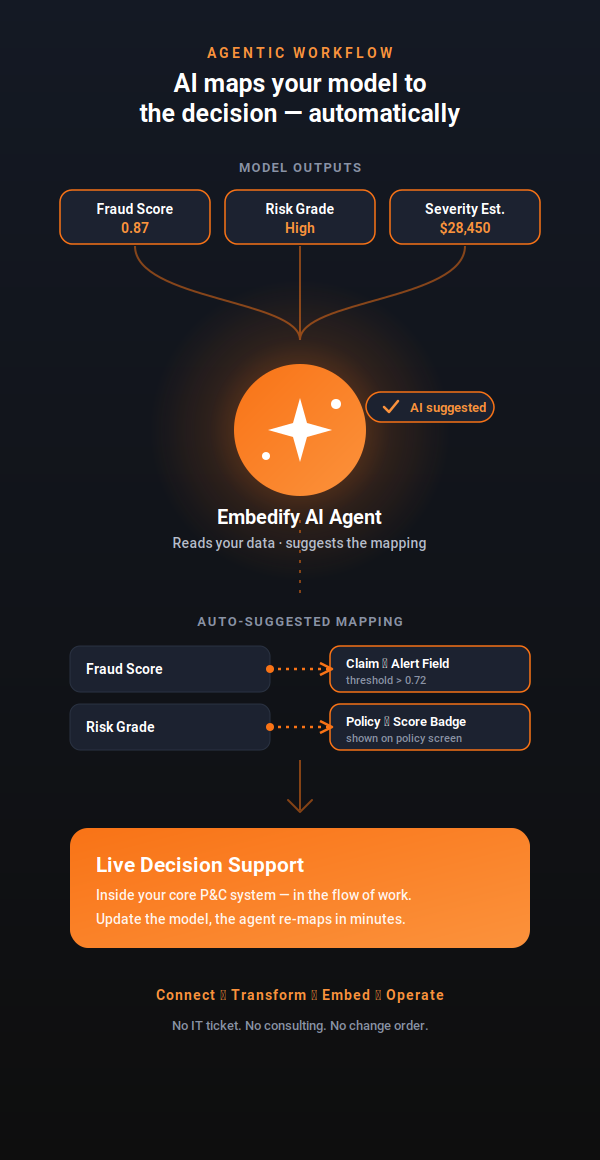
Use the visual field mapper or AI agent to define which model output a risk score, a fraud probability, a severity estimate maps to which field in your core system. See the mapping live in a preview before you save it. Create tasks, orchestrations, and actions with Embedify's drag-and-drop feature.
Set the trigger: policy submission, FNOL filing, renewal date, claim status change, or any other system event. Embedify handles the routing automatically and the right model runs at the right moment, every time, without anyone managing it manually.
Choose how the result surfaces to the user: as a score badge on the policy screen, a risk flag in the claims queue, a recommended action, or silently applied behind the scenes. Set threshold rules like 'flag this claim if fraud score is above 0.72' without writing any logic or code in your core system.
Run live test events through the integration before pushing to production. Embedify shows exactly what fired, what data moved, and what the user would see with full event logging. Confirm the result looks right before any real decisions are affected.
Push to production and monitor event volume, response times, and model outputs from the Embedify dashboard. When the model changes, update the endpoint or mapping and keep the workflow running without another integration project, consulting engagement, or change order.
Target outcome: from 400+ hours of custom development per model to same-day self-service configuration. Carriers move models from backlog to production in hours rather than months.
No scoping engagements, no change orders, no vendor retainers. Every dollar saved on integration is available to fund the next model or the ROI case for this one.
Carrier objective for first-year deployment: more model integrations live than were completed in all prior years combined. To be measured against actual customer outcomes as the platform matures.
Platform-design target: from initial configuration to live model outputs appearing inside core system workflows measured in hours, not weeks or months.
Embedify gives teams the freedom to configure how systems, data, models, and workflows work together, and helping organizations solve complex operational challenges without turning every change into a custom development project.
See how Embedify transforms integrations in your industry.
Schedule a demo or start a self-service configuration. No consulting. No change orders. No surprises.